
Berja: Springs, Mining Heritage and Sierra de Gádor
Berja lies on the western side of the Sierra de Gádor, a unique natural area designated by the European Union as a Site of Community Importance.
The Sierra de Gádor has a network of trails spanning nearly one hundred kilometres. The reference point for this network is the Parque Periurbano de Castala.
Nature
The area around the Fuentes de Marbella has been prepared for visitors. It is suitable for hiking and for observing the native flora and fauna.
Hiking makes it possible to visit many remnants of Berja's mining heritage.
Springs and Trails
The Ruta de las Fuentes runs through the streets and squares of Berja. Along it, more than thirty springs can be discovered.
As an urban route, the Ruta de las Fuentes is marked with stone slabs.
The Fuente de Alcaudique is the oldest spring on the route. It is of Roman origin.
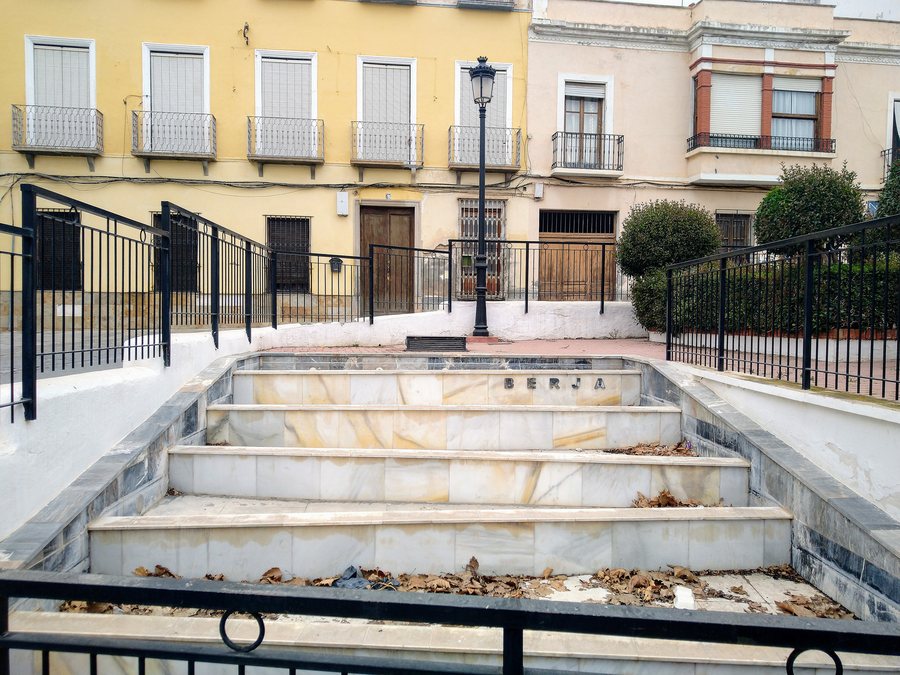
The Fuente de los 16 caños was built in 1859. It has a grand staircase and a round basin.
History and Architecture
The history of Berja is linked to the mining economy of the Sierra de Gádor.
Berja's historic mining heritage includes the ruins of smelting works and mines. The same mining heritage also includes the ruins of shafts, barracks, bridges and paths.
The Villavieja Archaeological Site includes the remains of a Roman amphitheatre.
The site includes the remains of a medieval fortified city. This medieval fortified city is considered the only known one of its kind in La Alpujarra.
The Villavieja Archaeological Site is considered one of the few cultural assets of special cultural interest in the area. This status has been in place since 1987.
The present-day church of Berja was founded in 1588 and is one of the most important pilgrimage centres in the Diocese of Almería.
It is an exceptional Neoclassical building with a basilica floor plan. Three naves are separated by large Tuscan stone columns.
In the church, architectural form and furnishings stand out as distinct features: the basilica floor plan arranges the three naves, while the large Tuscan stone columns separate them.
Sightseeing and Free Flight
Guided tours in Berja can be adapted according to visitors' interests.
During the guided tours, visitors' interests can determine the thematic focus. This keeps the selection of the aspects presented aligned with their particular interests.
The El Zarzalón Free Flight Station belongs to the Andalusian network of free-flight stations. It is located at an altitude of more than 600 metres.
Getting There
From the south, Berja can be reached via the provincial roads Al-6300 and Al-5300. Berja can also be reached from the south via the Adra–Berja regional road.
From the east, the El Ejido–Berja regional road leads there.
Both regional roads have direct access to the Autovía del Mediterráneo.
Other destinations include Pechina, Alhama De Almería, Guazamara, Fondón, Carboneras, Lubrín, Purchena and Cóbdar.
For the higher-level travel overview: Almeria.
Check prices, availability and amenities for your travel dates directly on Booking.com.
View accommodation and offersAdvertisement · Affiliate link to Booking.com
