
Sopalmo: Rambla, oleander and local history
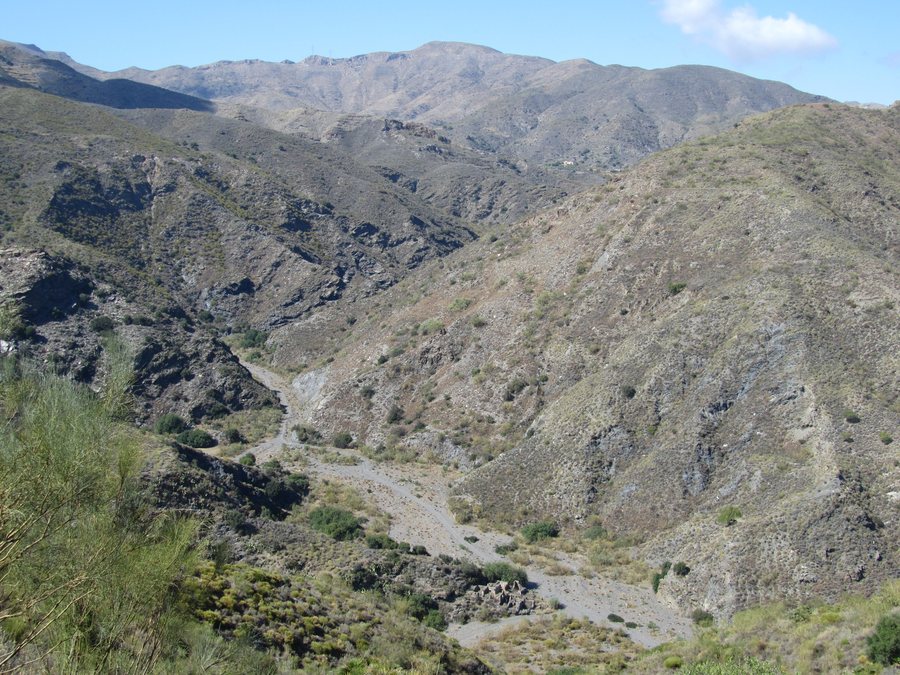 File:Casas abandonadas entre Sopalmo y La Adelfa (desde arriba) - panoramio.jpg
Photo: INDALOMANIA via Wikimedia Commons, CC BY-SA 3.0
File:Casas abandonadas entre Sopalmo y La Adelfa (desde arriba) - panoramio.jpg
Photo: INDALOMANIA via Wikimedia Commons, CC BY-SA 3.0
Hiking and cycling routes
The Sopalmo–Rambla de la Granatilla route takes 90 minutes there and back and is an easy downhill hiking and cycling tour. It begins in Sopalmo next to a small bar and follows the watercourse to its mouth at the sea.
The Sopalmo–Adelfa route is a moderately difficult hiking and cycling tour covering 14 kilometres there and back. It reaches Cerro de Adelfa at an elevation of around 742 metres. The car can be parked in Sopalmo for this route.
The Carboneras–Algarrobico–Sopalmo route passes through the Rambla de la Granatilla, Sopalmo and the Fuente de Sopalmo.
The connection to the Rambla de la Granatilla presents the starting point, watercourse and mouth as part of one continuous route description. The route begins in the village, follows the watercourse and ends where it flows into the sea. The stated duration of 90 minutes covers the journey in both directions.
The route to Adelfa is also described as a there-and-back journey. Its total length is 14 kilometres, while Cerro de Adelfa is the destination at an elevation of around 742 metres. The starting point for this tour is likewise in Sopalmo, where the car can be parked.
The longer route passes through several named points: from Carboneras via Algarrobico and the Rambla de la Granatilla to Sopalmo, and onward to the Fuente de Sopalmo. Thus, in addition to the village itself, the Rambla, the spring and Algarrobico are all part of this route.
Landscape
The Rambla Granatilla is characterised by volcanic rocks that cooled upon contact with the sea. The watercourse is also part of the Sopalmo–Rambla de la Granatilla route, which leads to its mouth at the sea.
The landscape of the Rambla therefore combines two explicitly named features: volcanic rocks and a watercourse whose course extends to the sea mouth. The rocks cooled upon contact with the sea; the mouth is also the endpoint of the route mentioned above.
History and culture
Sopalmo has a small chapel dating from the 20th century. A natural spring is located next to the chapel. Cristo Rey, the patron saint of Sopalmo, is celebrated in August.
The chapel combines a 20th-century building with a natural feature immediately beside it: the natural spring is located next to the chapel. The festival for Cristo Rey adds an annual religious occasion in August; Cristo Rey is referred to as the patron saint of Sopalmo.
Sopalmo grew in the 19th century, when the iron mines of Mena de Macenas were being exploited. The iron extracted from the Mena de Macenas mines was transported by cart to Garrucha, where it was smelted and loaded onto ships.
The history of the village is therefore also connected with a sequence of mining and transport activities. The iron came from the mines of Mena de Macenas, was taken by cart to Garrucha, smelted there and subsequently loaded onto ships. This sequence formed part of the development in the context of which Sopalmo grew in the 19th century.
Sopalmo was a meeting place for artists and painters.
To the main travel overview: Mojácar.
Check prices, availability and amenities for your travel dates directly on Booking.com.
View accommodation and offersAdvertisement · Affiliate link to Booking.com
_-_panoramio.jpg)