
Aljaraque: Marshes, Trails and Cultural History
Accommodation in Aljaraque
Aljaraque is home to the Marisma de las Carboneras, a protected tidal marsh in the urban surroundings of Corrales, Bellavista and Aljaraque; it borders the Paraje Natural Marismas del Odiel.
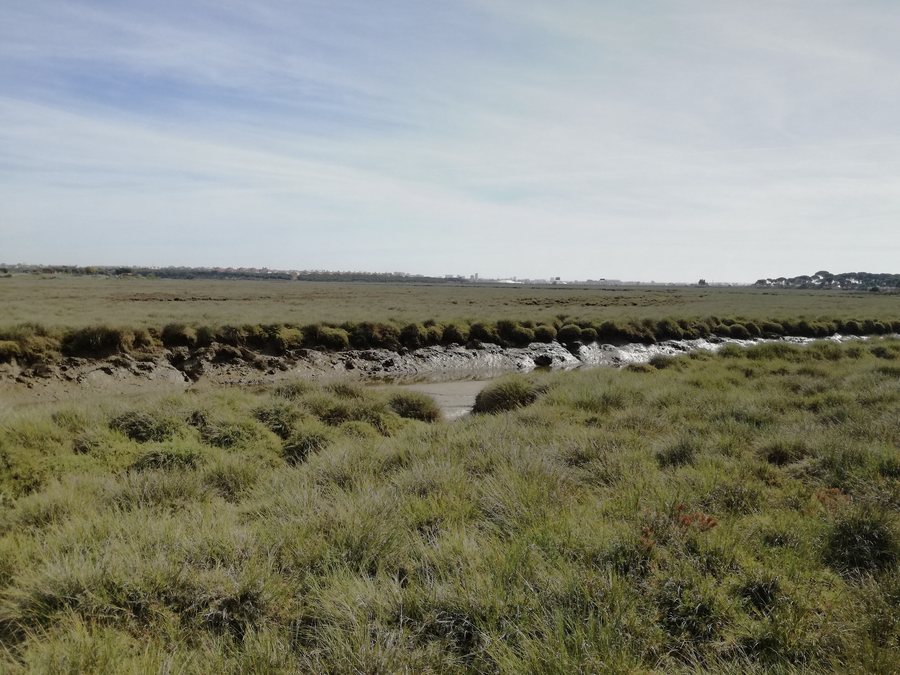 File:Marismas del Odiel, Aljaraque (Huelva).jpg
Photo: Alejandro Pereira via Wikimedia Commons, CC BY 2.0
File:Marismas del Odiel, Aljaraque (Huelva).jpg
Photo: Alejandro Pereira via Wikimedia Commons, CC BY 2.0
Nature
Its landscape features typical vegetation of the middle marsh, tidal channels and drainage ditches. Most of its substrate consists of silt and clay. Around 40 bird and other vertebrate species have been recorded in the Marisma de las Carboneras. Endangered species include the red-crested pochard, the black tern, the white-headed duck and the osprey.
The marsh can be explored via a municipal elevated wooden walkway that crosses the marshland. The walkway connects Corrales and Bellavista with the area of the former “Las Vegas” campsite. Aljaraque also has a belt of pine forest criss-crossed by numerous paths and trails. It leads into Mediterranean woodland with mastic shrubs, rosemary and rockroses.
Trails
The Vía Multimodal Marismas de Aljaraque is designated as a cycle path. Cyclists and pedestrians share it, and motor vehicles are prohibited. It was developed as an alternative connection to the conventional roads between the municipality’s four settlement centres. It has been enhanced as a tourism resource.
The Vía Verde Tharsis-Odiel is an approximately 30-kilometre-long, intermunicipal green infrastructure. It connects Huelva, Aljaraque and Gibraleón. It is open to the public.
The two routes have different spatial connections: the Vía Multimodal remains within the municipality and links its four settlement centres, while the Vía Verde is intermunicipal and connects Huelva, Aljaraque and Gibraleón. Their usage specifications are also clearly defined: on the multimodal route, cyclists and pedestrians share the path, while motor vehicles are excluded.
Culture and History
The tidal mill Molino mareal Las Cojillas in the Odiel Marshes of the municipality of Aljaraque was built before 1750. It used tidal energy for mechanical work, particularly for grinding grain.
The Casino Minero de Corrales began operating in 1918 as a cultural and leisure centre with a library. It was built by Cía. de Tharsis and served to entertain the company’s workers. The tower of the Iglesia de Nuestra Señora de los Remedios was built in 1757 by Joaquín Herrera based on a design by Pedro de San Martín.
Excavated structures in Aljaraque belong to a large settlement. They indicate a complex urban organisation.
Festivals
The Romería de Corrales is celebrated on the first weekend of May in Corrales, a district of the municipality of Aljaraque. The festival is held in honour of Nuestra Señora Reina del Mundo and San José Obrero. The Romería is recognised as a festival of historical, cultural and social value. Historical information about it is available to visitors.
More Destinations
Other destinations in the same higher-level region include Los Marines, Villablanca, Higuera De La Sierra, Minas De Riotinto, Veredas, El Cerro De Andévalo, El Álamo and Bollullos Par Del Condado.
Back to the higher-level travel overview: Huelva.

.jpg)