
Campofrío: Sierra, History and Trails
Accommodation in Campofrío
Landscape and History
Campofrío lies at the transition between the Sierra, with elevations of over 700 metres, and the Andévalo, which is characterised by rounded, gentle terrain. Dehesas with holm oaks and scattered stands of cork oaks cover the hills around Campofrío.
Culture
The Plaza de Toros de Campofrío was built in 1717 and is one of the oldest surviving bullrings. It is a significant example of vernacular architecture and lies next to the town centre in the El Chorrero area. As a Monumento and Bien de Interés Cultural, the Plaza de Toros de Campofrío is listed in the General Register of Andalusian Cultural Heritage. Illustrated panels next to the Plaza de Toros provide visitors with information about the history of the Coso de Santiago.
The Fuente-lavaderos de Las Cañadas, dating from 1878, comprises two washhouses next to the historic bullring. For decades, these washhouses served as a place of work and social exchange for the local women.
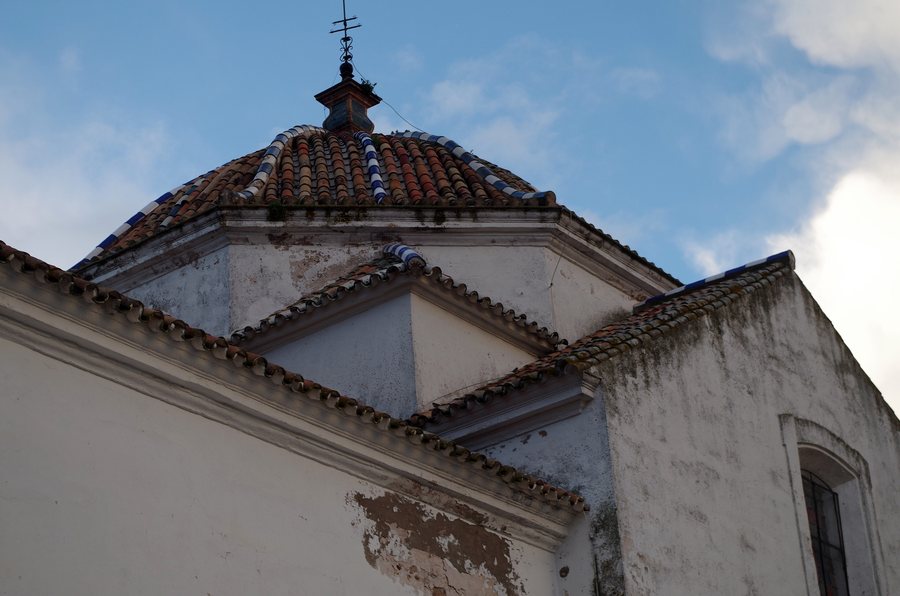
The Iglesia de San Miguel Arcángel is largely Neoclassical and preserves a Late Gothic sacristy from the late 15th century, which belonged to an earlier medieval temple. The church has a two-storey main altarpiece with a Doric entablature. It also houses a depiction of the archangel after whom it is named, whose carving comes from the school of Montañés.
Archaeological finds at Cerro de los Cobullos point to an Iberian castro, whose age may date back as far as the Late Bronze Age. At Risco del Tesoro there is a necropolis containing coins from the reigns of Trajan and Hadrian. Archaeological remains in Campofrío are connected with a history of the area spanning more than 5,000 years; Roman remains are particularly numerous.
Festivals and Crafts
The Romería in honour of the Santísima Trinidad follows a pilgrimage route from the hamlet of Ventas de Arriba to Campofrío on the Sunday before Corpus Christi. At this Romería, visitors receive the popular peach punch in the Plaza de España in Campofrío. The festival in honour of the patron saint Santiago Apóstol takes place over five days around 25 July and includes events at the Coso de Santiago.
Preparations made from Iberian pork include Adobao, a strongly seasoned dish made from offal. In Campofrío, Manuel Bermejo and Dolores Pérez work with clay in their workshop. Local craft traditions also include working with cork and wood, as well as anthropomorphic carvings on ladles and other household objects.
Trails and Nature
Campofrío has a network of trails providing access to its natural surroundings. The province of Huelva's trail network includes the Campofrío–Mina Concepción route, known as El camino del Odiel. The Camino de Santiago del Sur is signposted through the urban and rural areas of Campofrío.
The Cruz de los Dolores at Puerto de la Picota stands on a former Roman milestone. The viewpoint at the Cruz de los Dolores offers a view of the contrast between the mining landscape and the Sierra. The Puente Viejo del Odiel is a Roman stone bridge located approximately four kilometres north of Campofrío.
Getting There
The road connection from Huelva to Campofrío follows the N-435 (Huelva–Badajoz), which crosses the Sierra de Aracena and passes through Gibraleón, Beas, Valverde del Camino, Zalamea la Real and Riotinto.
Other Places
Other places: Almonte, Chucena, Molares, Puerto de la Laja, Encinasola, Las Delgadas, Punta Umbría, La Granada de Río-Tinto
To the main travel overview: Huelva.

