
Minas de Riotinto: Mining History on the Río Tinto
Accommodation in Minas de Riotinto
Mining History
The Museo Minero presents 5,000 years of mining history in 17 rooms. The museum is housed in the fully restored former hospital of the Rio Tinto Company Ltd. The historic archive of the Parque Minero de Riotinto preserves more than 5,000 years of mining history. The Parque Minero de Riotinto is the most important result of making the mining heritage accessible. This mining heritage was restored by the Fundación Río Tinto over almost four decades. The seven visitor sites of the Parque Minero de Riotinto cover 500 hectares across the municipalities of Minas de Riotinto, Nerva and El Campillo.
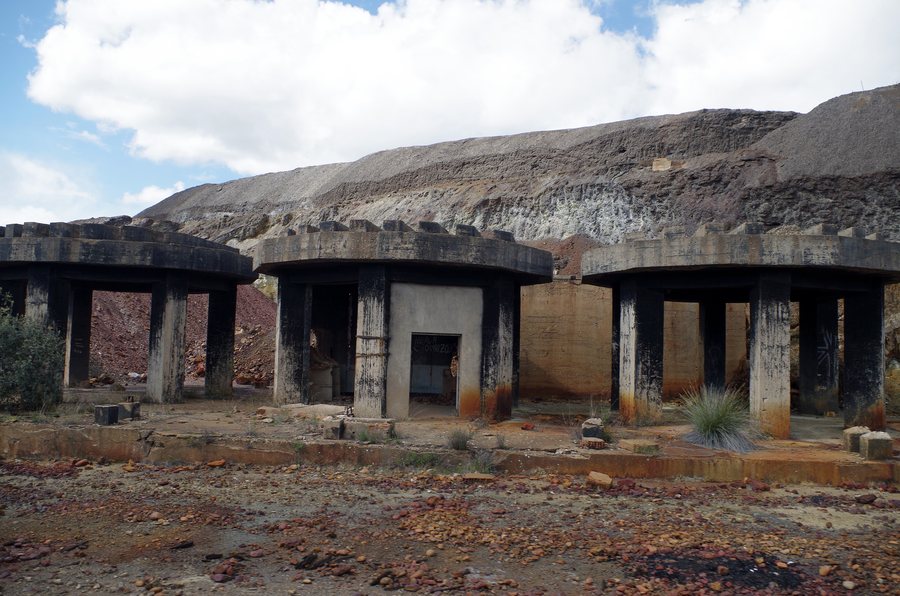 File:Minas de Riotinto 11 infraestructuras mineras by-dpc.jpg
Photo: David Perez via Wikimedia Commons, CC BY 4.0
File:Minas de Riotinto 11 infraestructuras mineras by-dpc.jpg
Photo: David Perez via Wikimedia Commons, CC BY 4.0
Cultural Heritage
The Cuenca Minera de Riotinto-Nerva is protected as a Zona Patrimonial. It includes the architectural and urban-planning heritage in Minas de Riotinto shaped by English influences. It also encompasses the mining districts and settlements of El Valle, Alto de la Mesa, La Dehesa and Bellavista. The Barrio Victoriano de Bella Vista was built in 1883 as a separate district. It was created for the growing English workforce. Casa 21 was built in 1885. Casa 21 provides insights into the lifestyle of the British community and its leisure habits around the turn of the 19th and 20th centuries. The Centro de Interpretación Etnológico Matilde Gallardo is an exhibition centre. Using various museographic elements, it explains the way of life of the mining community.
Railway and Walking Tours
The Ferrocarril Turístico Minero has restored part of the original railway line. From 1875 onwards, this line connected the mines with the port of Huelva. The Ferrocarril Minero runs on a round trip alongside the former ore-processing areas. The route also passes along the former railway facilities and is accompanied by the Río Tinto and its mining landscapes. A tourist tour lasts around 90 minutes. It is adapted to the development of the mining operations. A guided tour starts at the Museo Minero. The places open to visitors include La Tierra Roja and El Gran Muro Negro. Walking tours take place there. The development of mining in Minas de Riotinto spans several decades, from the railway line restored from 1875 onwards to the historic buildings constructed in 1883 and 1885.
Further Places
Discover further places via the following links: El Granado, Villalba Del Alcor, Bollullos Par Del Condado, Punta Umbría, Villablanca, Valdelarco, Encinasola and Hinojales.
Landscape along the Río Tinto
Corta Atalaya is an open-pit mine with an elliptical crater. At its widest point, the crater measures more than 1,200 metres. At its narrowest point, it measures 900 metres; its depth is 365 metres. The Río Tinto has red, highly acidic water. The pH value of this water is 2.2. Microorganisms live in the Río Tinto. They feed on minerals and are adapted to extreme conditions.
To the higher-level travel overview: Huelva.

