
Molares: History, Townscape and Hiking Trails
Accommodation in Molares
History and Visible Traces
Written records documenting the existence of Los Molares date back to 1579.
There are numerous archaeological finds from different periods in the area around Los Molares. Among the earliest documented finds are handmade pottery fragments from a prehistoric period that has not been dated more precisely. The prehistoric dating therefore remains open, while the handmade pottery is precisely identified as a type of find. Some tegulae, that is, Roman roof tiles, attest to a Roman presence in the area around Los Molares.
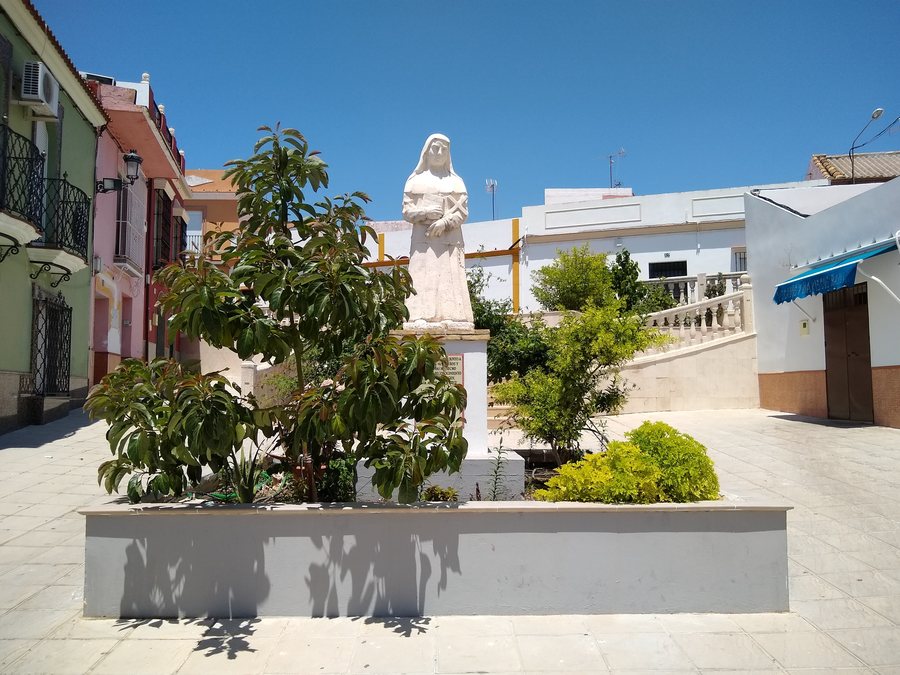 File:Santa Ángela de la Cruz (Los Molares).jpg
Photo: CarlosVdeHabsburgo via Wikimedia Commons, CC BY-SA 4.0
File:Santa Ángela de la Cruz (Los Molares).jpg
Photo: CarlosVdeHabsburgo via Wikimedia Commons, CC BY-SA 4.0
The history of the town is therefore not limited to written records but is also evident in preserved objects and structural traces. The pottery fragments represent an early period that has not been dated more precisely, while the tegulae point to the Roman presence in the area.
If you would like to explore local history through visible traces, traditional “llanos”—mosaics made of stones—can be found in front of some houses in Los Molares. Large millstones can still be seen in Los Molares and its surroundings. The name Los Molares derives from the millstone used in mills for grinding.
The millstones thus connect a visible feature of the town with its name. The “llanos”, on the other hand, can be seen in front of some houses and are made of stones, so the two forms of design are immediately distinguishable in the townscape.
Townscape and Historic Paths
Los Molares developed on both sides of a former mule track that connected Almonaster with Los Romeros and El Repilado.
The church of Los Molares was built by the residents themselves in the 1940s. Its slender bell gable makes it the settlement’s most prominent building. Patron-saint festivities were held in Los Molares in July 2024.
Almonaster la Real
Los Molares can be reached via the A-470. The town is five kilometres from Almonaster la Real. Nearby Almonaster la Real, five kilometres from Los Molares, is home to a castle fortress dating from the 9th century.
The nearby Almonaster la Real, also five kilometres from Los Molares, is home to the mosque-church of Nuestra Señora de la Concepción. It is classified as a Bien de Interés Cultural.
Nature and Hiking Trails
The landscape along the official Almonaster–Los Molares hiking trail includes holm oaks, cork oaks, eucalyptus trees, rockroses, blackberries and broom. Wildlife listed along this hiking trail includes foxes, badgers, ichneumons and wild boar.
A circular route starting in Almonaster la Real passes several named points. Iglesia Los Molares is a named stop after 8.4 km. The historic circular hiking trail “Los Romeros–Aguafría–Fuente del Oro–Los Molares–Los Romeros” is 10 km long. For your planning, a specific route length of 10 km is given for this historic loop.
On the route from Almonaster la Real, Iglesia Los Molares is listed as a named stop after 8.4 km. The historic circular route, by contrast, specifies a sequence from Los Romeros via Aguafría, Fuente del Oro and Los Molares back to Los Romeros. Both details therefore refer to clearly named route itineraries.
More Destinations
More destinations complement the selection of towns: Ayamonte, Santa Bárbara De Casa, Valdelarco, Aljaraque, Moguer, Cortegana, Lucena Del Puerto, Galaroza
For the overarching travel overview: Huelva.

.jpg)