
Niebla: Walls, Castle and Paths along the Río Tinto
Accommodation in Niebla
Culture and History
In Niebla, the historic centre and the walls were declared a historic-artistic monumental complex in 1982.
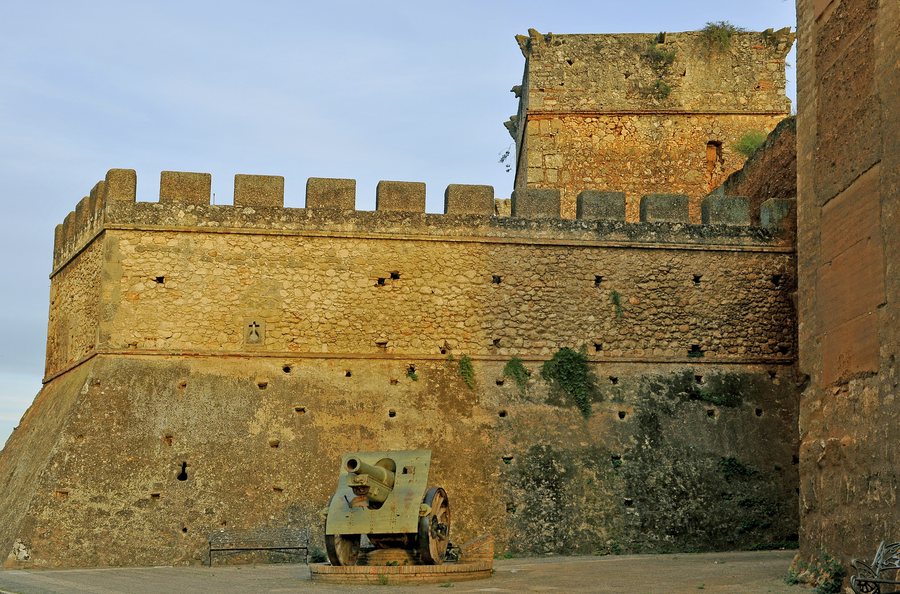
The Castillo de Niebla, also known as Castillo de los Guzmanes, has Roman origins, preserves elements of the former Arab alcázar and, in its present layout, has a basic form dating from the 15th century.
The Iglesia de Santa María de la Granada combines an Arab mosque and a Gothic-Mudéjar church; its surviving features include numerous original Islamic elements from the late 10th or 11th century.
The same church also preserves Visigothic episcopal remains and Roman columns.
The Puente Romano de Niebla is located at the entrance to the town, crossing the Río Tinto, and its eastern section contains fully preserved Roman structural elements.
The Roman bridge stands on the foundations of an older bridge that formed part of the Antonine Itinerary to Itálica and Hispalis.
The Barbacana del Castillo de Niebla is protected as a Bien de Interés Cultural.
Its restoration aimed to restore the profile and silhouette of the fortress, as well as its relationship with the walled town.
Restoration work also reinstated the historic access to the fortress of Niebla through the Puerta del Grillo.
As part of these measures, a walkway along the upper battlements of the fortress was created once again.
The town-wall walkway is a tourist route that provides access to Niebla’s fortified district.
The Murallas de Niebla are protected as a Bien de Interés Cultural, have pre-Roman origins and show Roman as well as Islamic traces.
They comprise 46 square towers, two octagonal towers and several gateways.
The Puerta del Agua is one of the monumental gates of Niebla’s late-medieval town wall.
The Iglesia de San Martín was built on a site that had previously served as a mosque and synagogue; an apse structure from the 15th century and a portal at the western end of the church have survived.
The museum space of the former Nuestra Señora de los Ángeles Hospital, a 16th-century building that is now the Casa de Cultura, displays some of the numerous remains from Niebla.
Paths and Landscape
The Puerta Verde San Juan-Niebla is a 16-kilometre linear route of low difficulty that connects Niebla and San Juan del Puerto.
Along the route there are rest areas as well as sections adapted for people with reduced mobility.
The route runs mostly along the Río Tinto and offers opportunities for cycling, nature observation and hiking, as well as archaeological points of interest.
A short walking trail leads to the Copper Age megalithic complex at Mesa de las Huecas, which consists of three dolmens.
Niebla lies on the Ruta al-Mutamid and preserves buildings with Arab-influenced architecture.
Festivals
The Feria de Tosantos takes place on the first weekend of November and includes a horse fair, where horses have traditionally been traded, as well as the Exponiebla trade and exhibition fair featuring products from the region.
In September, Capeas take place in Niebla during the patron-saint festivities in honour of the Virgen del Pino.
More destinations: San Silvestre De Guzmán, Linares De La Sierra, Cumbres De San Bartolomé, La Nava, Punta Umbría, Cartaya, Las Delgadas, Santa Olalla del Cala.
To the main travel overview: Huelva.

