
Andalusian Olive Oil: Varieties, Origin and Buying on a Trip
Andalusian olive oil is more than just a souvenir to discover on a trip. By visiting mills, markets or restaurants, you can compare its origin, variety and flavor firsthand. To help you choose, ask yourself one simple question: should the bottle mainly remind you of your trip at home, or will you use it regularly for cooking?
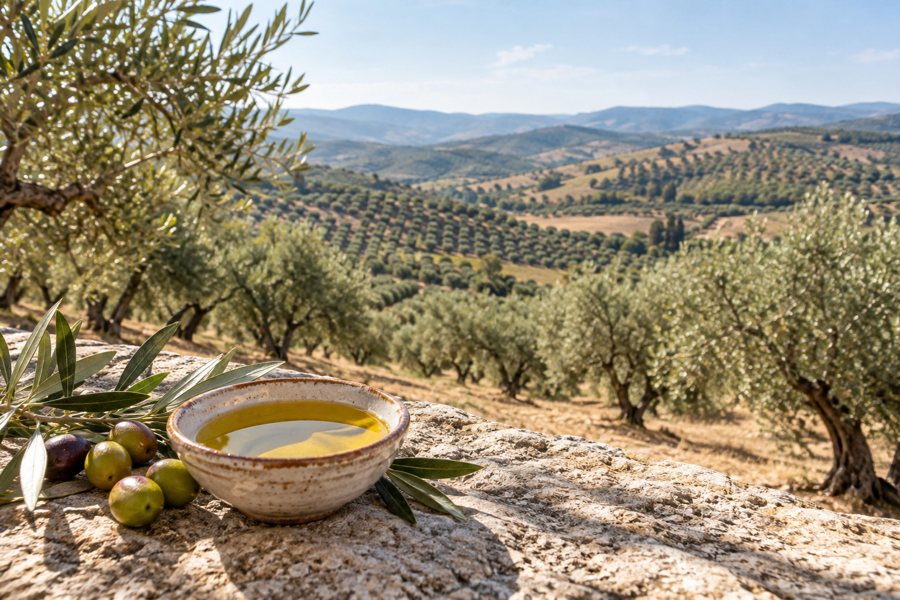 KI-Symbolbild: Olivenhain, Oliven und eine Schale Olivenöl; keine dokumentarische Aufnahme eines bestimmten Ortes.
Photo: MaxTD / OpenAI
KI-Symbolbild: Olivenhain, Oliven und eine Schale Olivenöl; keine dokumentarische Aufnahme eines bestimmten Ortes.
Photo: MaxTD / OpenAI
Quick facts about Andalusian olive oil
- Andalusia is one of Spain’s leading olive oil regions, and the province of Jaén in particular shapes the landscape.
- Olive oil can taste fruity, mild, bitter or peppery. A robust flavor is not automatically a sign of poor quality.
- The variety, origin, harvest details and quality seals on the label provide useful guidance when buying.
- During a tasting, aroma, fruitiness, bitterness and pungency are assessed together.
- If you plan to buy directly from a producer or visit a mill, check opening hours and whether you need to book in advance.
- For the journey home, a small bottle with a secure closure and protective, break-resistant packaging is usually the most practical choice.
Olive-growing landscapes and suitable travel routes
Travelers can experience the largest continuous olive-growing landscape in the province of Jaén. Towns and villages are scattered among the groves, making it easy to put together a culinary itinerary. Baeza and Úbeda combine historic architecture with excursions into the surrounding countryside. A drive through the hinterland of Córdoba can also bring together culture, cuisine and agriculture. If you would like to take in the landscape at a slower pace, the overview of Andalusia’s landscapes offers ideas for further stops.
Origin, varieties and quality seals
Andalusian olive oil is not a single, uniform product. Aroma, fruitiness and pungency vary depending on the area and variety. Common varieties include Picual, Hojiblanca, Picuda and Arbequina. Protected designations of origin and geographical indications can help with comparisons by making the origin and established production requirements easier to verify. An official overview from the Junta de Andalucía of quality designations for olive oil explains the different PDO and PGI labels. Even so, travelers should read the specific label when buying rather than assume the flavor based solely on the name of a region.
Assessing flavor during a tasting
A tasting begins with the aroma. Fruity notes may bring to mind green leaves, herbs or ripe olives. Bitterness and pungency often become apparent on the palate and can vary in intensity. What matters is whether the oil tastes clean and balanced, and suits your intended use. Color alone says little about quality, which is why it is often not a focus in professional tastings.
Planning a mill visit and tasting
An olive mill, farm shop or food business can offer a vivid explanation of how olives are grown and processed. Before visiting, find out whether tours are available in German or English, whether you need to book, and whether you can buy products on site. Opening hours may vary by season, especially outside the harvest period. If you would rather not make a special trip to a mill, you can ask for a small sample at a market or restaurant. The general guide to tourism in Andalusia can help you fit these visits into a longer itinerary.
Buying olive oil and transporting it safely
For a gift, small glass bottles or tightly sealed tins are usually easier to handle than large containers. Before buying, check the best-before date, the statement of origin and the closure. When traveling by car, protect the oil from direct heat and keep it upright. Air travel has specific limits on liquids in carry-on luggage; for larger quantities, check the latest requirements of the airline and airport. An extra leakproof bag and protective padding can help protect clothing and luggage, but do not replace the applicable transport rules.
Olive oil in the kitchen and travel planning
At home, you can pair the oil with Andalusian cuisine: milder varieties go well with bread, vegetables or salad, while more robust oils can accompany grilled fish or hearty dishes. The choice depends on your personal taste and how you plan to use it. If you want to follow the journey from cultivation to the table, you can combine information about agriculture in Andalusia with a stay in Seville or Córdoba. That way, the bottle becomes more than a souvenir: it gives you a tangible connection to the places you visited and the dishes you enjoyed.
FAQ about Andalusian olive oil
What does AOVE mean?
AOVE stands for “Aceite de Oliva Virgen Extra,” or extra virgin olive oil. The term refers to a defined quality category; the label, origin and flavor are still important when deciding what to buy.
Which region is particularly well known for olive oil?
Jaén is especially shaped by olive cultivation, making it a good destination for a trip focused on olive oil. Other Andalusian provinces also have their own varieties, landscapes and protected designations of origin.
Does bitter or pungent oil mean it has gone bad?
Not necessarily. Bitterness and pungency can be characteristic flavors of certain varieties and fresh oils. A distinctly rancid or otherwise faulty smell would be more concerning.
How do you plan a tasting?
Check the location, opening hours, language and booking requirements in advance. A small tasting can often be combined easily with a market visit, sightseeing or a drive through olive-growing country.
How should olive oil be transported by car?
Seal the bottle tightly, keep it upright and cushion it to protect it from knocks. Avoid exposing it to direct heat in a parked car.
Can you take olive oil on a plane?
The applicable liquid rules apply to carry-on luggage. Before departure, check the latest requirements of your airline and airport if you plan to take larger bottles or several containers.
